Serviced Apartment SEO Case Study: 856,856 Organic Pageviews
A UK serviced apartment site drove 856,856 pageviews and 9,104 direct-booking enquiries in 12 months. All organic. Here is the architecture that did it.
 Chris McCrow
 The result: Relocation Apartments, a global corporate-housing and serviced apartment site we built and grew, drove 856,856 pageviews, 236,471 visits and 9,104 enquiry-form page views in a single twelve-month window, from 100% organic search. Zero paid ads. Zero social traffic of any consequence. Every visit came from someone typing a location-intent search into Google and landing on a page built to rank for it. Here is the architecture that made it work - and why the same decisions compound for any SA operator serious about reducing OTA dependency.
Part of our client work and results.
If you’re a serviced apartment operator, you already know the maths on OTAs. A guest booked through Booking.com costs you 15 to 20 percent of the stay in commission. The same guest arriving directly through organic search costs you nothing but the rent on your website. Over a year, that gap pays for a lot.
The question every operator we talk to is really asking is: can direct organic traffic actually replace OTA volume at scale, or is this a story agencies tell to sell websites?
Relocation Apartments is the case study we point them at.
The Site at a Glance
- Name: Relocation Apartments (relocationapartments.com)
- Sector: Global serviced apartments, corporate housing, and medium-to-long stay - a directory-style site aggregating demand across UK, Europe, North America, and Asia-Pacific.
- Scale: Over 700 individual property pages, plus dedicated landing pages for major city and district destinations. The site had 2,412 distinct indexable URLs at peak.
- Traffic channel mix: Organic search first, organic search second, organic search third. No paid Google or Meta budget in the reporting period. No meaningful social referral traffic.
- Lead mechanism: A central enquiry form routed prospective guests straight to the reservations team.
Relocation Apartments is no longer live - it was retired when the operator consolidated their domain portfolio - which is partly why we can talk about the data openly rather than hedging around a currently active client.
The architecture scales in both directions. The principles behind these numbers work the same way whether you’re a directory with 700 properties or an operator with 5 apartments. One dedicated indexable page per location, property, or stay-type intent. That’s it. We’ll come back to what this looks like at smaller scale further down.
The Results
Over a consecutive twelve-month reporting period, the site delivered:
| Metric | 12-month total |
|---|---|
| Pageviews | 856,856 |
| Visits | 236,471 |
| Total requests (hits) | 2,277,734 |
| Enquiry-form page views | 9,104 |
| Pageviews per visit | ~3.6 |
| Peak month pageviews | 102,600 |
| Peak month enquiry-form views | 954 |
| Monthly pageviews range | 40,444 to 102,600 |
| Median month pageviews | ~70,000 |
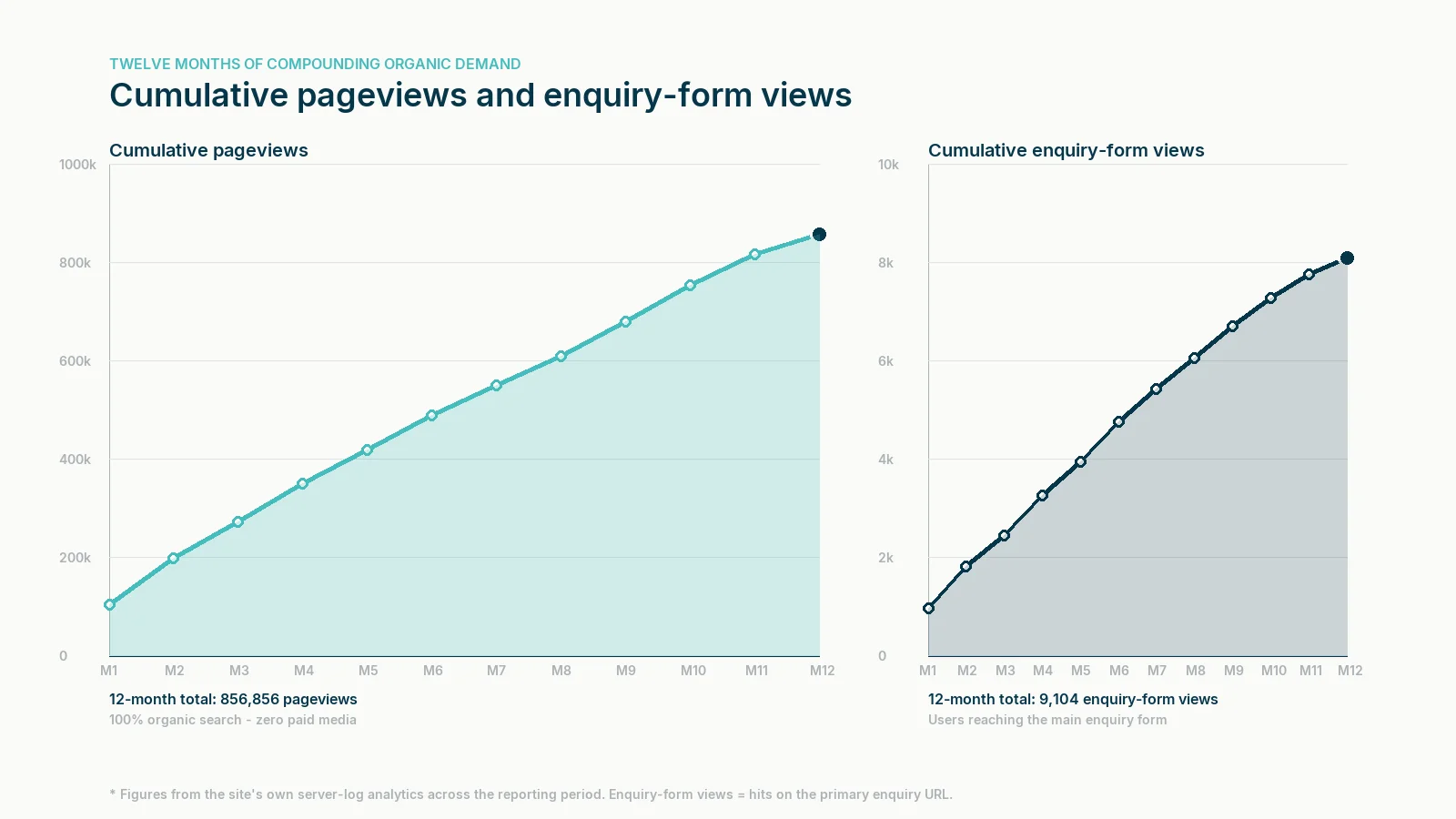
Over 9,000 users reached the primary enquiry form in twelve consecutive months, and monthly pageviews never dropped below the five-figure band. This is not a site that got lucky with one viral hit. It is a site that ranked across a portfolio of location-intent queries and kept delivering qualified traffic, month after month, from pages that had been indexed and trusted.
That shape is what direct-booking marketing is meant to look like. Flat month-to-month volatility. No reliance on paid budget being on. No dependence on a single keyword ranking. Just a catalogue of pages, each one ranking for the searches that match its inventory, each one quietly sending interested people toward the enquiry form.
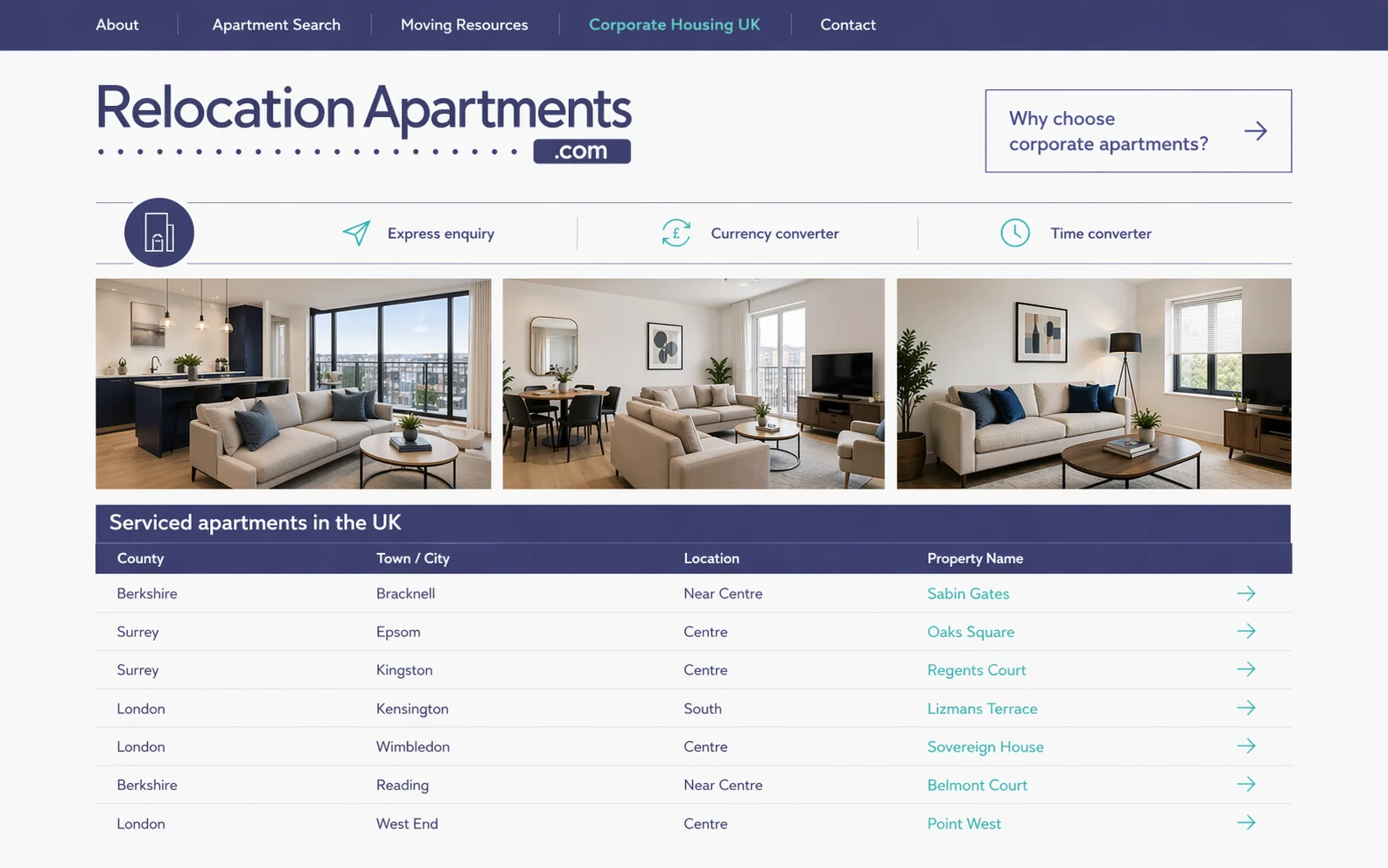
Above: a faithful likeness of the Relocation Apartments UK directory. The original site is retired.
What the Funnel Means Commercially
The 9,104 enquiry-form views are the step where commercial intent actually shows up. At a typical enquiry-to-booking conversion rate of around 10%, those 9,104 views translate to roughly 900 direct bookings across the year - each one a booking taken at full margin rather than surrendering 15 to 20 percent to an OTA on the stay value.
The lever is specific and easy to project for your own operation: your expected monthly enquiries × 0.1 × (your average stay value × your OTA commission rate) gives you an annualised commission-saving figure for moving that same volume of enquiries through your own website rather than through Booking.com or an equivalent. The bigger the volume of enquiries your site can generate organically, the bigger that number becomes - which is why the architectural decisions that move the enquiry-view count are what matter.
The Four Architecture Decisions That Drove It
This is the part that transfers. The website itself was simple. The decisions behind it were not.
1. A Focused Landing Page per Destination and per Property
The site published one dedicated URL per meaningful destination - city, district, or individual property - each page targeted at the specific search phrase a guest would use for that place. Not one “locations we cover” page listing everywhere. Not a search-results page returning a filtered list.
This is the single most load-bearing SEO decision a serviced apartment site can make, and it is the one most operators still get wrong. A guest searching “serviced apartments Reading” is a different person with different intent from a guest searching “serviced apartments UK”. The first is ready to book. The second is at the top of the funnel.
If your site has one page for all your locations, you’re competing with the OTAs on a query neither of you will decisively win. If your site has a dedicated page per location, you’re competing on a query the OTAs treat as a generic filter and you treat as your home turf. That’s a winnable fight.
This is the same logic behind the location pages in every modern W4B build. One location, one indexable page, one specific search intent - not a single “our properties” page trying to rank for everything at once. The deeper argument for location-intent targeting, with keyword examples and the conversion economics behind it, is in our SEO for serviced apartments guide.
2. Keyword-Intent URLs
Every URL on the site named the destination or property it served. A prospective guest searching for accommodation in, say, Kingston upon Thames saw that location in the URL of the result that came back. Google’s ranking model has changed in many ways since, but keyword-aligned URLs have never stopped being a signal.
The specific technology doesn’t matter here. Whether the URL is generated by a static HTML file, a modern headless framework, or a CMS, the principle is the same: the URL should describe what the page is about, in words a guest and a search engine can both read.
3. Structural Speed
The site was fast because of what it didn’t have. No heavy rendering layer. No plugin stack loading before the content appeared. No database round-trip on every page load.
Page speed is now a formal Google ranking factor - it wasn’t then, and this site was still getting credit for it. The underlying lesson is technology-agnostic: whether you’re on WordPress, a modern framework, a headless CMS, or plain HTML, the pages that rank are the pages that show up quickly. If your current site takes more than 2.5 seconds to render the largest visible element on mobile, Google is quietly downranking you against competitors whose sites don’t.
4. Patience
Twelve months of flat, five-figure monthly pageview volume is the shape of a site that is being rewarded by Google for compounding authority. It is not the shape of a one-month paid push. Operators who expect organic traffic to hit a peak in month one and plateau the way a paid campaign does will walk away from the strategy before it pays back.
The organic curve typically looks like this: quiet for months, a gradual rise as pages index and rank, and then a sustained volume that keeps showing up long after the initial build work is paid for. This case study is that curve at the top of its range.
What This Means for Your Site
The architecture scales to any size. A five-property operator doesn’t need 700 pages - they need a dedicated, indexable page for each property, each destination they serve, and each stay-type their guests search for. The question to ask is not “can I replicate 856,000 pageviews.” The question is:
- How many of the destinations, properties, and stay types you serve have their own dedicated, indexable page with unique content? If the answer is “one” or “none”, you have a location-page problem and it is almost certainly the biggest organic-growth lever on your site.
- How fast does your current site render the largest visible element on a mobile device? If it’s over 2.5 seconds, Google is quietly downranking you against faster competitors for exactly the queries your guests are searching.
- How long have you given your current site to compound, and has it been actively indexed and built on in the last twelve months? Organic does not work as a short campaign. It works as a long commitment, and the operators who win are the ones who understood that going in.
Our free short-let marketing cheat sheet covers the technical SEO and website fundamentals worth checking first, as a practical starting point for your own site.
Frequently Asked Questions
Can you show similar results for a smaller operator?
The 856,856-pageview total reflects a large directory site with hundreds of destination and property pages. The more instructive point for a smaller operator is the per-page behaviour: pages built around a specific location and stay-type intent, indexed and maintained, will rank and deliver traffic at a steady monthly rate. Operators with a handful of locations see proportionally smaller absolute numbers, but the same compounding shape - which is often enough on its own to meaningfully reduce OTA dependence.
How long before the traffic shows up?
Organic takes three to six months to start producing meaningful volume for a new or rebuilt site, and twelve to eighteen months to reach the kind of flat, compounding baseline this case study shows. If an agency promises you organic results in weeks, they are either conflating organic with paid or overselling the channel. We prefer to tell you the honest timeline up front, and the clients who win with us are the ones who commit to it.
How does this translate into bookings?
The number to look at for commercial intent is the mid-funnel figure: 9,104 users reached the primary enquiry form in twelve months, with 954 reaching it in the strongest month alone. That’s the step where visitors demonstrate buying intent, and it’s the step most comparable to what a modern site would register as an enquiry lead in a CRM. Converting that intent into confirmed bookings depends on your pricing, inventory, and enquiry-handling process, which are client-specific - it’s why we don’t publish booking-conversion numbers without a direct attribution window.
What does the free audit actually give me?
The free audit scores your site on performance and technical SEO, identifies the specific fixes most likely to move the needle on organic visibility, and delivers a prioritised action list in a branded PDF report. What the audit alone can’t do is know your specific locations, stay-types, or competitive landscape - that context comes from you, and the optional follow-up conversation is where we translate the audit findings into a growth plan specific to your properties.
Serious about reducing OTA dependency and building organic traffic that compounds? Grab our free short-let marketing cheat sheet for the checklist covering where sites typically leak direct bookings. When you’re ready to commission the rebuild, our serviced apartment website design service is built on the same architecture.
About this content: This article was created with AI-assisted research and drafting, then reviewed and refined by Chris McCrow. I set the direction, provide the expertise, and own every word published. Learn about our content approach.
Chris McCrow
Founder of Website for Bookings. Specialist marketing for serviced accommodation since 2017.
Related Articles
Want to talk it through?
Book a free call with Chris. We will look at where your direct bookings stand and what would move them.