How B&Bs and Guest Houses Get More Direct Bookings (UK, 2026)
What Booking.com costs a UK B&B, what you can and cannot offer direct under narrow rate parity, and the website changes that move guests to book with you.
 Chris McCrow
The short answer: A UK B&B on Booking.com typically pays around 15% commission, set in its own agreement rather than published. You cannot show a lower public price on your own website than on Booking.com, because the UK still has narrow rate parity. You can offer direct guests a better deal in other ways: a perk, a members’ rate behind an email sign-up, or a lower price by phone or email. The website’s job is to make booking direct easy, and obviously worth it.
Part of our series on direct booking website design.
Most B&B and guest house owners we speak to know the commission hurts. Fewer know exactly what they are allowed to do about it. This guide covers both: the numbers, the rules, and the changes to your website that move guests from the OTA app to your own booking page.
What Booking.com actually costs a B&B
Booking.com does not publish a commission rate. It sits in your accommodation agreement. UK independents typically pay around 15%, the market range runs from about 10% to 25%, and the Preferred Partner programme adds roughly 3 points. Commission is charged on the room and on extras booked through the platform. If you take payments through Payments by Booking.com, a payment fee of 1% to 3.1% sits on top.
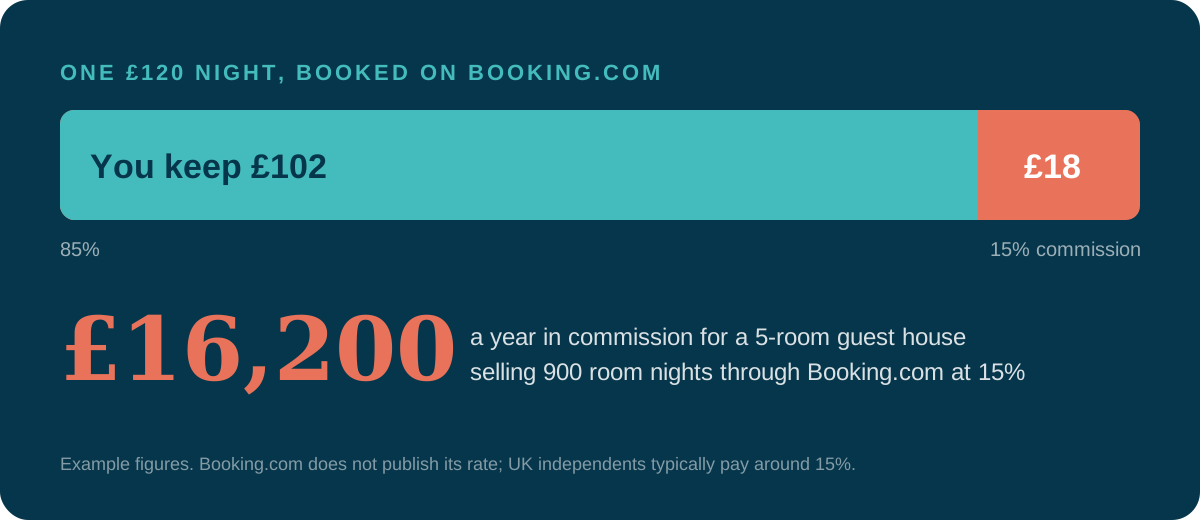
On a £120 night, 15% is £18. For a five-room guest house selling 900 room nights a year through Booking.com, that is £16,200 a year at the same rate. Our OTA commission rates guide has the figures for every platform, with links to where each one comes from, and the OTA calculator works out your own number.
A direct booking is not free either. A standard UK card payment through Stripe costs 1.5% plus 20p, and your website and booking system have running costs. The gap is still large enough that every guest you move to direct matters.
What you can and cannot offer direct (narrow parity)
Booking.com still lists the UK as a narrow parity country. Inside the EU, the parity clause was removed in December 2024 under the Digital Markets Act; that change does not apply here.
What narrow parity means in practice:
- Not allowed: a lower public rate on your own website than the rate you load on Booking.com, for the same room, dates and cancellation terms.
- Allowed: the same public rate plus a perk that only direct guests get. Late checkout, free parking, a welcome drink, a free dog, flexible cancellation, a room upgrade on arrival.
- Allowed: a lower rate behind a login, a “returning guests” tab or a code sent to your email list, as long as it is not shown publicly or pushed to Google as your direct price.
- Allowed: a lower price quoted by phone, email or WhatsApp.
- Allowed: a different product at a different price, such as non-refundable, or a minimum two-night stay.
Airbnb has no parity clause at all. If you list there too, your own pricing is up to you.
Five website changes that move guests to book direct
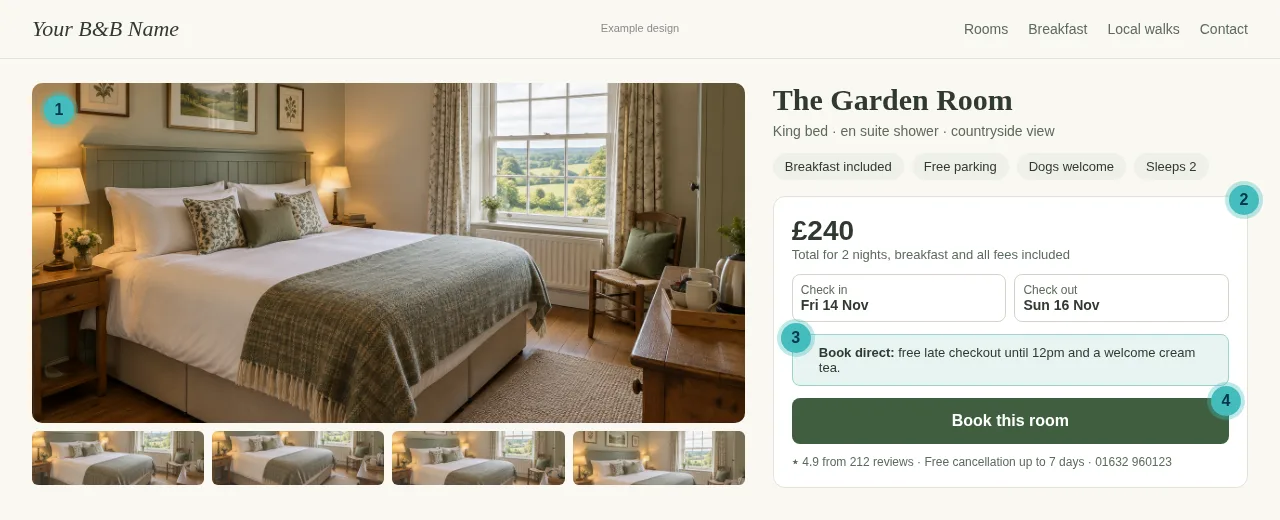
An example room page, not a client site. Marked: (1) photos of the room, (2) the total price for the dates, (3) the reason to book direct, (4) one clear book button.
1. Give every room its own page
Guests book a room, not a building. A page per room with its own photos, bed size, bathroom type and price “from” lets a guest choose without leaving your site. One gallery for the whole house sends them back to the OTA, where each room is laid out side by side.
2. Put a live booking button on every page
An enquiry form is not enough for most guests in 2026. If they cannot see availability and pay, they go back to the app they already have open. Most B&B booking systems (Beds24, Freetobook, eviivo, Little Hotelier and others) include a booking engine your website can use. Check yours is on the site, not hidden behind a “Book” link to a different-looking page.
3. Say why booking direct is better, near the button
A guest comparing your site with your Booking.com listing sees the same price. Tell them, next to the book button, what they get by booking with you: the perk, the flexible cancellation, the direct line to you. If the reason is not on the page, the guest will not guess it.
4. Show the total price before card details
Since April 2025, UK law (the DMCC Act 2024) requires the headline price to include every mandatory charge. If you add a cleaning or booking fee, include it in the price you show, or show it alongside the nightly rate at the same size. This also builds trust: guests used to OTA checkouts are wary of fees appearing at the last step.
5. Answer breakfast, parking and dogs on the page
These three questions fill most B&B inboxes. Answer them on the room pages and next to the book button. Each question a guest has to email about is a moment where they might book somewhere else that already answered it.
How to get guests who found you on Booking.com to come back direct
You cannot use a Booking.com guest’s email address for marketing, and you should not promote direct booking inside Booking.com messages. You can still:
- Make your name memorable during the stay. Your website address on the welcome card, the breakfast menu and the receipt you hand over.
- Ask for permission to stay in touch, in person or with a sign-up card, and send returning guests your members’ rate.
- Make sure your own site ranks for your own name. Many guests who found you on an OTA search for you by name before booking. If your website is slow or hard to book on, they go back.
Where to start
If you are not sure which of these your site already does, start with the checklist on our guest house and B&B website design page, or get a free audit written for B&Bs. We check your site, room pages, booking flow and Google visibility, and send back the first fixes worth making.
Commission and parity figures checked against Booking.com partner help pages and UK government guidance in October 2026.
About this content: This article was created with AI-assisted research and drafting, then reviewed and refined by Chris McCrow. I set the direction, provide the expertise, and own every word published. Learn about our content approach.
Chris McCrow
Founder of Website for Bookings. Specialist marketing for serviced accommodation since 2017.
Related Articles
Where is your booking site losing guests?
A specialist reviews your site and shows where visitors drop out before they book, with prioritised fixes. Free, delivered within 2 working days.